
Athens, Greece / Dammam, Saudi Arabia – 22 September 2026
PROTASIS and GCC Electrical Testing Laboratory (GCC Lab) announce the successful completion of the testing and certification of the PROTASIS® Power Plant Controller (PPC) against the Saudi Arabian Grid Code (SAGC) and the Technical Requirements for Grid Code (TRGC).
The certification follows a comprehensive Real Time Digital Simulator (RTDS) Hardware-in-the-Loop (HIL) testing program performed by GCC Lab to assess the controller’s performance under simulated grid operating conditions. The testing program evaluated the PROTASIS® PPC across a broad range of active power, reactive power, voltage control and advanced grid-support functions. GCC Lab’s final technical assessment concluded that the test results demonstrate that the PPC fulfils the requirements evaluated under SAGC and TRGC.
The successful certification represents an important milestone for PROTASIS, providing independent validation of the PPC’s advanced control capabilities against Saudi grid requirements and reinforcing the company’s commitment to the Saudi Arabian power and renewable energy market.
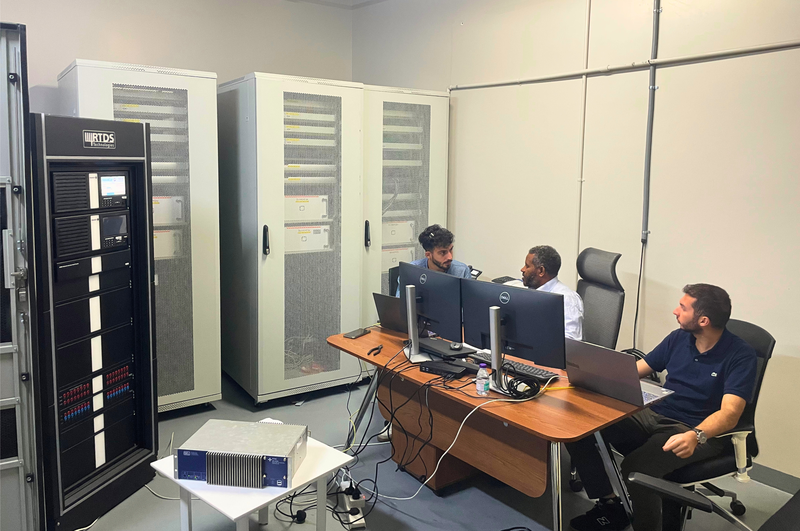 PROTASIS and GCC Lab teams during Real Time Digital Simulator Hardware-in-the-Loop testing
Advanced controller validation through RTDS Hardware-in-the-Loop Testing
As part of the certification process, GCC Lab developed a grid-connected power plant model in RSCAD and interfaced it with an actual PROTASIS® Power Plant Controller through an RTDS environment. This configuration enabled real-time measurements from the simulated electrical system to be exchanged with the physical controller, while active and reactive power reference commands generated by the PPC were communicated back to the simulated plant.
This closed-loop HIL environment enabled the dynamic behavior of the controller to be evaluated across a broad range of operating scenarios and grid-support requirements.
The certification program covered key active power control functions, including active power setpoint control, ramp rate control, primary frequency response, absolute power limitation and delta regulation. The PPC was also evaluated across reactive power and voltage control functions, including voltage control, reactive power control, power factor control and Q-V droop control.
In addition, the testing program assessed advanced grid-support capabilities, including Power Oscillation Damping and Synthetic Inertia / Fast Frequency Response, as well as control hierarchy requirements such as automatic prioritization of grid-support functions and control based on validated measurements at the Point of Interconnection (POI).
The results confirmed the successful performance of the PROTASIS® PPC across the evaluated functions and demonstrated that the controller fulfils the relevant SAGC and TRGC requirements.
The certification program provided a comprehensive assessment of the PROTASIS® Power Plant Controller using GCC Lab’s RTDS Hardware-in-the-Loop testing capabilities. Through the evaluation of active power, reactive power, voltage control and advanced grid-support functions, the testing successfully demonstrated the controller’s ability to meet the relevant SAGC and TRGC requirements. This type of validation is increasingly important as modern power systems integrate increasing levels of renewable generation and require advanced, reliable plant-level control capabilities.
Eng. Fahad AlHamzi, CEO of GCC Lab
 PROTASIS and GCC Lab teams following the successful certification of the PROTASIS® Power Plant Controller
Supporting reliable and grid-compliant Power Plant Operation
The PROTASIS® Power Plant Controller is designed to provide centralized plant-level control for renewable and other grid-connected generation facilities. By coordinating individual generating units and plant assets, the PPC manages the overall response of the facility at the Point of Interconnection (POI) and enables the plant to respond to grid operator setpoints and requirements for active power, reactive power, voltage and frequency response.
Its control architecture supports a wide range of operating modes and grid-support functions, enabling power plants to respond dynamically to changing system conditions while maintaining reliable and coordinated operation.
As power systems evolve and the share of renewable generation continues to grow, advanced plant-level control is becoming increasingly important for maintaining grid stability and supporting reliable system operation. At PROTASIS, we are continuously investing in technologies that address these emerging requirements and enable power plants to operate effectively within increasingly demanding grid environments. The successful certification of our PPC by GCC Lab is an important recognition of this effort and a significant step in supporting our continued growth in the Saudi Arabian market.
Vassilis Georgiou, PROTASIS CEO
About GCC Lab
GCC Electrical Testing Laboratory (GCC Lab) provides independent engineering design validation, testing, inspection and certification services for the power and energy sector. Its capabilities include power system studies, renewable energy and grid-code compliance verification, asset assurance and technical consultancy services for utilities and energy-sector organizations.
