OT Cybersecurity

OT Cybersecurity
privacy-security-ssl-1851271237

Engineering-led Cybersecurity for Resilient Operations

Modern operational technology (OT) environments are increasingly connected to enterprise IT, remote access solutions, cloud platforms and third-party services. While this connectivity supports more efficient operation and maintenance, it also introduces cybersecurity risks to systems where safety, availability and operational continuity are critical.

PROTASIS combines cybersecurity and engineering expertise in power systems and industrial automation to help organizations identify vulnerabilities, assess operational cyber risk, implement security improvements and strengthen cybersecurity governance.

Our services can be delivered independently to address a specific need or combined into an integrated cybersecurity improvement programme. Our approach takes account of applicable cybersecurity legislation and regulatory requirements, alongside relevant standards, best practices and frameworks. These may include ISA/IEC 62443, NERC CIP and the Saudi NCA Operational Technology Cybersecurity Controls (OTCC), depending on the organization’s activities, operational environment and project scope.

Our OT Cybersecurity Services

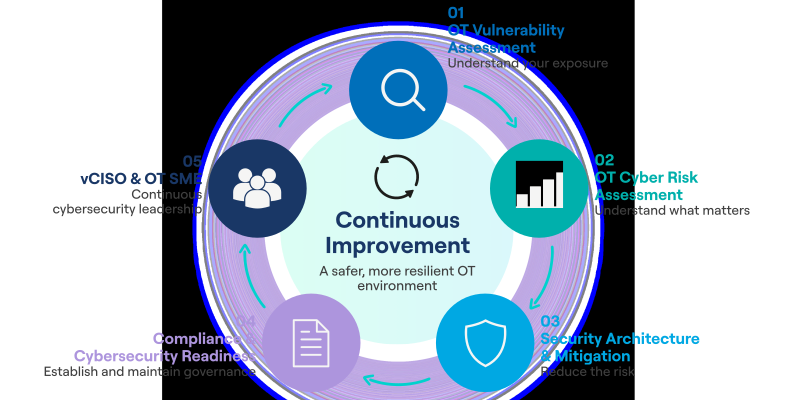
Our five complementary services help organizations understand their exposure, prioritize risks, strengthen protection and sustain cybersecurity governance across OT-intensive operations.

PROTASIS OT cybersecurity services diagram

  • Power Generation
  • RES & BESS
  • Transmission & Distribution
  • Oil, Gas and Petrochemicals
  • Heavy Industries
  • Smart Urban Solutions
  • Marinas
  • Infrastructure
  • Data Centers

Understand your Exposure

Our OT Vulnerability Assessment identifies technical, architectural and configuration weaknesses that could affect industrial systems and their safe, reliable operation. Assessment methods are adapted to the operational environment to minimize disruption to production systems.

Key Features

  • Asset & Architecture Visibility: establish or validate the OT asset inventory, network topology, system interconnections, communication protocols and critical dependencies.
  • Technical & Configuration Review: assess software and firmware exposure, insecure services and protocols, system configurations and remote-access paths.
  • OT-Safe Assessment Methods: combine documentation review, passive observation and carefully controlled technical assessment methods appropriate to the operational environment.
  • Prioritized Findings & Recommendations: document weaknesses and recommend remediation actions based on technical exposure and operational relevance.

Benefits

Gain a clear view of OT weaknesses and exposure, with practical recommendations to guide remediation planning.

  • Power Generation
  • RES & BESS
  • Transmission & Distribution
  • Oil, Gas and Petrochemicals
  • Heavy Industries
  • Smart Urban Solutions
  • Marinas
  • Infrastructure
  • Data Centers

Our OT Cyber Risk Assessment identifies and evaluates credible cyber risk scenarios affecting critical operational functions. We consider threats, vulnerabilities and existing safeguards alongside potential impacts on safety, availability, production, equipment and business operations.

Key Features

  • Risk Scenario Identification: identify credible cyber scenarios affecting critical OT assets, functions, communications and operational dependencies.
  • Likelihood & Consequence Assessment: evaluate the likelihood of each scenario and its potential operational, safety, financial and business consequences.
  • Risk Evaluation & Prioritization: assign risk levels using an agreed methodology and prioritize risks according to their significance to the organization.
  • Risk Treatment Planning: define proportionate technical, procedural and organizational measures to address the assessed risks.

Benefits

Make informed decisions about cybersecurity priorities and investment by focusing on the scenarios with the greatest operational and business significance.

Understand what matters

  • Power Generation
  • RES & BESS
  • Transmission & Distribution
  • Oil, Gas and Petrochemicals
  • Heavy Industries
  • Smart Urban Solutions
  • Marinas
  • Infrastructure
  • Data Centers

Reduce the Risk

We translate assessment findings and risk scenarios into practical security designs and mitigation roadmaps tailored to the operational environment. Our approach applies ISA/IEC 62443 principles to help organizations strengthen protection while respecting operational requirements.

Key Features

  • Policies, Procedures & GRC Measures: develop or improve OT cybersecurity policies, procedures, governance controls, roles and responsibilities, and supporting risk-management practices required to implement and sustain identified mitigation measures.
  • Secure OT Architecture: design or improve zones and conduits, OT DMZs, IT/OT connectivity, industrial firewalling and network segmentation.
  • Secure Access: define measures to strengthen remote and vendor access, identity and access controls, and privileged access to critical systems.
  • Monitoring & Detection: define requirements for passive OT monitoring, centralized logging and integration with SIEM/SOC services.
  • Phased Mitigation Roadmap: prioritize security improvements, taking account of risk reduction, operational constraints and implementation dependencies.

Benefits

Establish a practical path to reducing cyber exposure, with security measures designed around the needs of the installation and its operations.

  • Power Generation
  • RES & BESS
  • Transmission & Distribution
  • Oil, Gas and Petrochemicals
  • Heavy Industries
  • Smart Urban Solutions
  • Marinas
  • Infrastructure
  • Data Centers

We help organizations assess their cybersecurity readiness and prepare for applicable obligations and industry requirements across IT and OT. Our services focus on identifying gaps, establishing governance and organizing the evidence and actions needed for improvement.

Key Features

  • Regulatory Readiness: assess gaps and required actions against applicable cybersecurity requirements, including NIS2 and the EU Network Code on Cybersecurity, where relevant.
  • ISA/IEC 62443 Alignment: use relevant principles and requirements to structure OT cybersecurity governance, risk assessment, architecture and controls.
  • Governance & Policies: develop or improve policies, roles and responsibilities, risk-management processes and incident governance.
  • Supply Chain & Third-Party Security: cybersecurity expectations and oversight processes for OEMs, EPCs, O&M providers and other critical suppliers.
  • Readiness & Maturity Roadmap: translate findings into prioritized actions with defined ownership, supporting evidence and management visibility.

Benefits

Build a structured view of cybersecurity readiness and a clear improvement plan to support governance, regulatory preparedness and internal accountability.

Strengthen governance and regulatory preparedness

NIS2 Directive

  • Power Generation
  • RES & BESS
  • Heavy Industries
  • Infrastructure
  • Data Centers

central cybersecurity unit

Continuous OT cybersecurity leadership

Our Virtual Chief Information Security Officer (vCISO) service provides strategic oversight for organizations where OT is core to the business, connecting corporate IT and OT cybersecurity across their operations and assets.

For specific needs, standalone OT Subject Matter Expert (OT SME) support provides ongoing expertise in agreed areas, including security architecture, risk management, technical requirements and remediation planning, without a full Virtual CISO engagement.

Key Features

  • Cybersecurity Strategy & Roadmap: define priorities, improvement programmes and investment plans aligned with business objectives, operational risk and applicable obligations.
  • IT & OT Governance: coordinate cybersecurity responsibilities and decision-making across management, IT, engineering, operations and external providers.
  • Risk & Remediation Oversight: oversee assessments, remediation plans and security architecture initiatives, and track progress against agreed priorities.
  • Regulatory & Supplier Oversight: coordinate readiness activities and cybersecurity requirements for projects, technology suppliers and operational partners.
  • Incident Preparedness & Executive Reporting: support escalation and coordination arrangements, and provide management with visibility of cyber risk, maturity, decisions and progress.

Benefits

Access ongoing cybersecurity leadership without establishing a full-time internal CISO function, with coordinated oversight of IT and OT risk and improvement activities.

PROTASIS combines cybersecurity expertise with practical engineering experience in electrical power systems, industrial automation and operational technology. We understand how control systems, communications and operational dependencies interact, enabling us to assess cybersecurity issues in the context of the processes they support.

Our experience in the energy sector informs an engineering-led approach to cybersecurity across industrial and critical infrastructure environments. We help clients define proportionate, risk-based measures that address cyber exposure while respecting safety, reliability and operational requirements.

Systems & Environments we support

  • Electrical Substation Automation Systems (SAS)
  • SCADA & Industrial Control Systems (ICS)
  • Distributed Control Systems (DCS)
  • Power & Energy Management Systems (PMS / EMS)
  • PV, Wind & BESS control systems
christopher-burns-Kj2SaNHG-hg-unsplash
blue-light-2254394945

blue-light-2254394945

The same vulnerability can have very different consequences depending on the asset, process and operational function it affects. Effective OT cybersecurity therefore requires both cybersecurity expertise and an understanding of the underlying engineering systems.

Contact us to find out the ideal solution for you

Contact Us
Searching...