
Held from 23 to 28 August at the Palais des Congrès in Paris, the CIGRE Session brought together the international power systems community to exchange knowledge and discuss the evolving challenges facing electricity generation, transmission and distribution.
PROTASIS was represented by its CEO, Vassilis Georgiou, together with Vassilis Evangelopoulos and Aris Tsimtsios, who presented the two papers during the poster sessions.
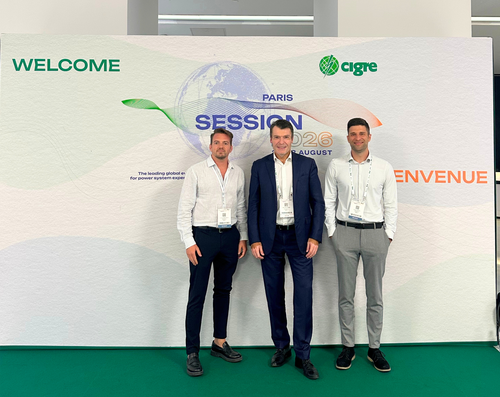 PROTASIS CEO Vassilis Georgiou with team members Vassilis Evangelopoulos and Aris Tsimtsios during the CIGRE Paris Session 2026.
Ensuring resilient data center operation through hybrid power generation
"Analysis of the Robust Operation of a Hybrid Power Station Incorporating Diesel Generators and Battery Energy Storage Systems in a Novel Data Center Electrical Topology"
Main author: George Karvelis | Presenter: Vassilis Evangelopoulos
The rapid growth of artificial intelligence, and particularly Generative AI (GenAI), is placing increasing demands on data center infrastructure, making power supply resilience and service continuity more critical than ever.
As data centers scale to accommodate increasingly demanding computational workloads, conventional backup power supply architectures based on individual diesel generators are evolving towards more centralized and flexible configurations that combine conventional generation with battery energy storage.
The paper examines the operation of a Hybrid Power Station (HPS) incorporating diesel generators and Battery Energy Storage Systems (BESS), designed to support data center operations under islanding conditions. The analysis focused on developing a detailed simulation model of the HPS and assessing its ability to maintain system stability and service continuity across a range of dynamic operating scenarios.
Transient stability simulations were used to investigate the interaction between the different generation units and evaluate the performance of the proposed electrical topology. The analysis demonstrated stable data center operation across most of the examined dynamic scenarios, providing valuable insights into the conditions required to ensure secure islanded operation.
The study highlights the importance of accurate modelling of the dynamic behaviour of critical power components when designing resilient data center infrastructure. Such analysis can support informed decisions on system configuration and operating strategies, including the appropriate application of Grid-Forming (GFM) and Grid-Following (GFL) control modes.
By examining the dynamic interaction between BESS and conventional generation, the work provides a framework for assessing and improving the reliability and performance of hybrid power architectures as data center power requirements continue to evolve.
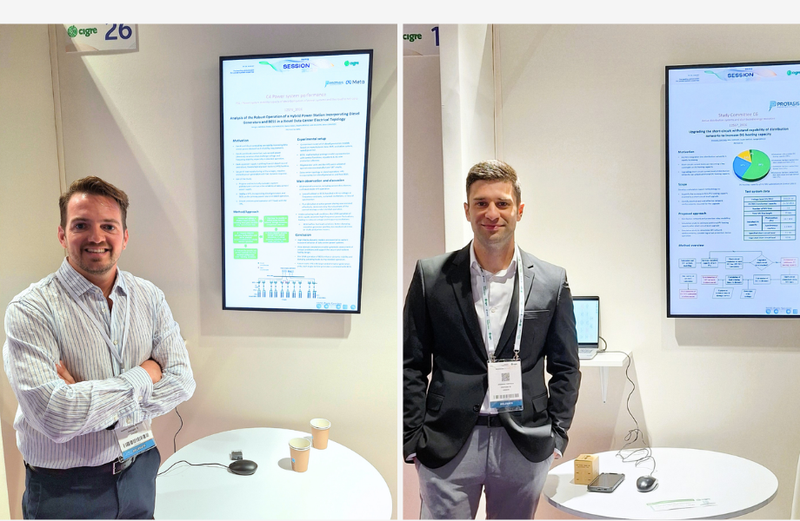 Vasilis Evangelopoulos and Aris Tsimtsios presenting their poster at the CIGRE Paris Session 2026.
Increasing DG hosting capacity through targeted network reinforcement
"Upgrading the Short-Circuit Withstand Capability of Distribution Networks to Increase DG Hosting Capacity"
Main author & presenter: Aris Tsimtsios
The growing penetration of distributed generation is creating new challenges for Distribution Network Operators (DNOs) seeking to accommodate additional renewable generation while maintaining safe and reliable network operation.
While network reinforcement is frequently associated with voltage constraints, increased DG penetration can also raise short-circuit current levels beyond the withstand capability of existing equipment. This can become a limiting factor for further DG integration and require targeted upgrades at HV/MV substations and across distribution networks.
The paper presents a pilot study examining the short-circuit withstand capability of an HV/MV substation and its associated distribution lines. The analysis assessed the actual short-circuit current levels and existing PV hosting capacity of the network and developed a methodology for identifying the reinforcements required to safely accommodate additional distributed generation.
A key consideration was to determine the interventions actually required to ensure equipment resilience to short-circuit thermal stress, while avoiding overly conservative recommendations that could lead to unnecessary investment. This was achieved by taking into account fault clearing times resulting from the operation of actual network protection devices.
The proposed methodology supports DNOs in developing safe and practical reinforcement strategies, enabling greater integration of distributed generation while optimizing the investments required to strengthen the network.
Connecting engineering practice with international technical dialogue
Through the presentation of these two papers, PROTASIS contributed engineering insights into two areas undergoing significant transformation: the development of resilient power infrastructure for increasingly demanding data centers and the ability of distribution networks to accommodate higher levels of distributed generation.
The 2026 Session also marked an important distinction for the Greek power systems community, with the CIGRE Medal 2026 awarded to Nikolaos Hatziargyriou, Professor Emeritus at the National Technical University of Athens, recognizing his longstanding contribution to CIGRE through Study Committee C6, the Greek National Committee and several of the organization’s scientific bodies.
PROTASIS’ participation in CIGRE reflects its focus on connecting engineering practice and project experience with the international technical dialogue around the reliability, resilience and evolution of modern power systems.
