
The Zafarana 50 MWp photovoltaic project in Egypt is a characteristic example of how this challenge can be addressed through a comprehensive digital infrastructure for monitoring, control, and interaction with the grid.
The project was developed under the KfW framework and serves the national transmission system through the Egyptian Electricity Transmission Company (EETC) and the New and Renewable Energy Authority (NREA). Implementation was carried out by the EPC consortium of Belectric Gulf Ltd, Consolidated Contractors Group S.A.L., and Consolidated Sicon Power Company S.A.L., within which PROTASIS S.A. undertook the full design, implementation, testing, and commissioning of the plant’s digital infrastructure.
Unified PV SCADA & PPC system for real-time monitoring and control
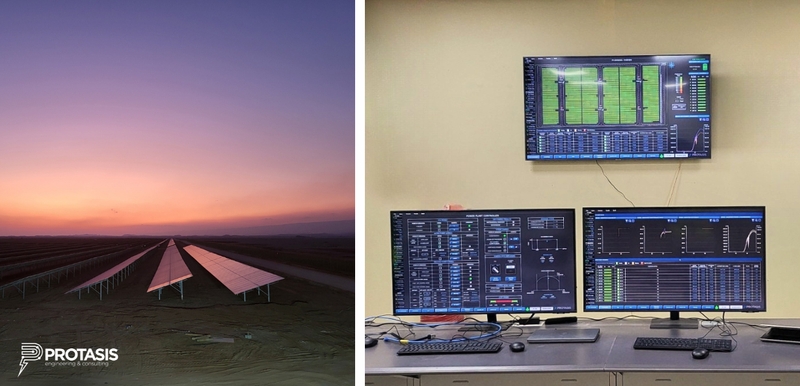 The operations of the photovoltaic park, its substations, and all installed equipment are integrated into a unified SCADA digital environment, enabling comprehensive real-time monitoring and control.
The installed solutions PROTASIS® PV SCADA and PROTASIS® Power Plant Controller (PPC) operate as a single, complementary system that goes beyond monitoring, extending to the control of power generation and the plant’s behavior toward the grid. Inverters, string combiner boxes, meteorological stations, and MV/HV substations are integrated into a common SCADA digital environment that provides:
- Real-time operational visibility
- Structured alarm management
- Evaluation of performance ratio, availability, and energy losses
- Tiered user access (local and remote)
Within a comprehensive control framework, the PPC implements:
- Active and reactive power regulation
- Voltage and frequency control
- Dynamic response at the Point of Common Coupling (PCC) through advanced algorithms
These features allow the plant to operate as a predictable and controllable generation unit. For the needs of the project, the Power Plant Controller algorithm was adapted in accordance with the applicable Egyptian Grid Code (RfG). Compliance was verified and certified by the Transmission System Operator (EETC).
RTDS: Verifying real behavior before grid connection
A key element of the project was the certification of the solution through RTDS (Real-Time Digital Simulator) hardware-in-the-loop testing, in accordance with the NTS v2.1 standard. In this environment, grid behavior was simulated in real time and the PPC response was tested prior to final field installation.
This process doesn’t simply confirm compliance with the grid code; it demonstrates with measurable data that the plant will behave exactly as required under real operating conditions. In this way, the integration of the photovoltaic plant into the transmission system is achieved with technical certainty and minimized risk during commissioning.
Digital infrastructure that defines RES reliability
The Zafarana PV project in Egypt proves that the success of a large-scale RES project is not determined solely by installed MW capacity, but also by:
- the plant’s level of digital maturity
- the quality and response time of control systems
- the ability to interact with the grid
- the use of data for real-time optimal decision-making
A unified visualization across local and remote teams enhances efficiency, reduces fault response time, and increases plant availability.
International presence and recognition at EGYPES 2026
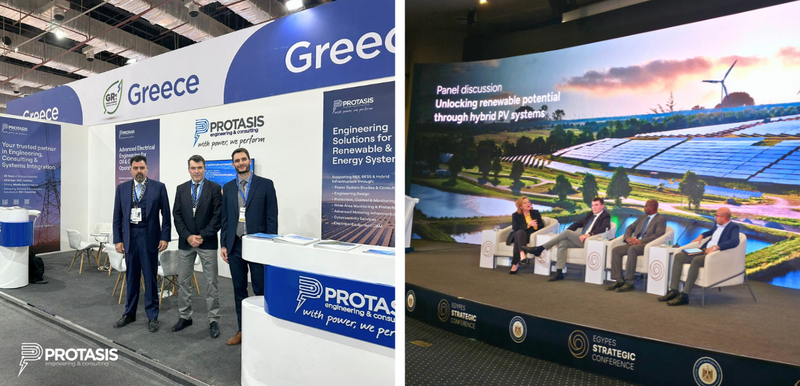 PROTASIS had a strong presence at EGYPES 2026, representing Greece at the national pavilion and at the Strategic Conference.
The project’s technical approach was presented at the EGYPT ENERGY SHOW (EGYPES) Strategic Conference, where it was highlighted as a benchmark example of digital RES integration in a large-scale project.
The project was also selected among the top three finalists in the category “Scaling Renewable Projects in Egypt” at the event’s Energy Awards.
For PROTASIS, this project serves as a reference point for how a fully functional PV SCADA system and a certified Power Plant Controller can transform a photovoltaic plant into an active, reliable, and fully controllable component of a national energy system.
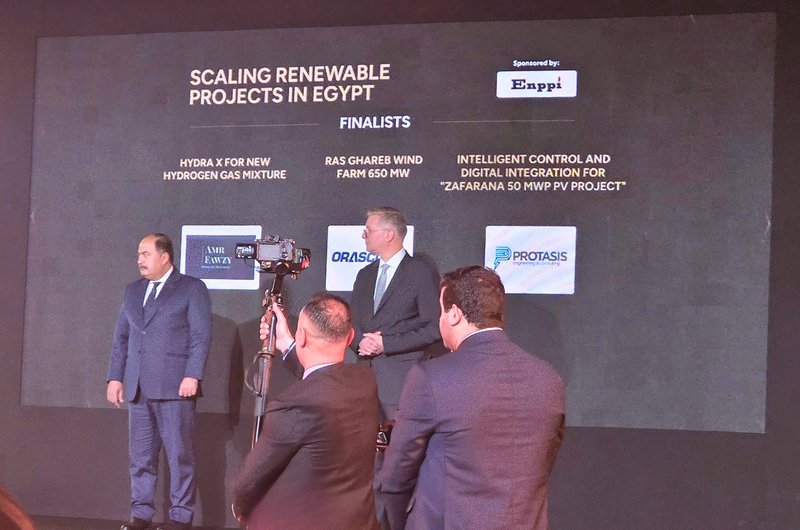 The PROTASIS project in Zafarana placed the company among the top three finalists at the EGYPES Energy Awards 2026 in the category “Scaling Renewable Projects in Egypt.”

