
The project “Hybrid System for Electricity and Heat Production from Renewable Energy Sources (RES) on Agios Efstratios Island”, implemented by GEK TERNA, represents a significant milestone in the island's journey towards sustainable energy autonomy. The system integrates a 0.9 MW wind turbine, a 0.2 MW photovoltaic installation, a 2.56 MWh battery energy storage unit, and a 1.005 MW district heating network. It is engineered to cover more than 85% of the island’s electricity demand, significantly minimizing reliance on traditional heating sources.
At the core of the project is the Hybrid Energy Management and Control System (HEMCS), developed and commissioned by PROTASIS S.A., as a subcontractor to GEK TERNA. This system is essential for the efficient coordination of renewable energy sources, battery storage, and existing diesel generators, enabling seamless integration and optimized operation of all components.
How the System Operates
Following the deployment of the hybrid station, the island’s electrical system operates under three distinct modes:
- Mode 1: Fully Autonomous Operation: Only the Hybrid Station (RES and battery storage) is active, handling voltage and frequency regulation on its own.
- Mode 2: Conventional Diesel Operation: Power is supplied solely by the Local Power Station’s diesel generators replicating the pre-existing condition.
- Mode 3: Hybrid and Diesel Combined Operation: The Hybrid Station takes the lead in managing voltage and frequency, while diesel units either run at fixed outputs or share the load dynamically under HEMCS supervision.
The HEMCS effectively manages transitional states, such as shifting between hybrid-only and diesel-assisted modes, while ensuring swift and reliable responses to emergencies like battery malfunctions, RES disruptions, or generator failures.
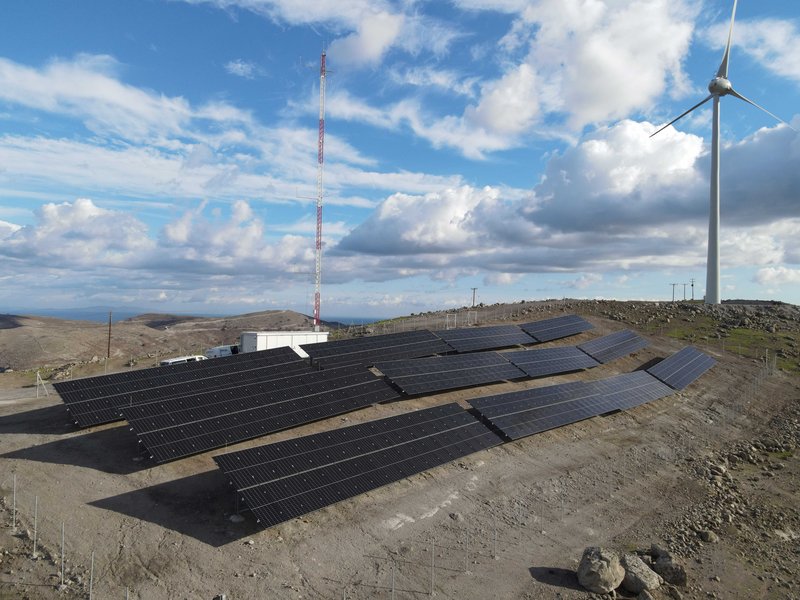 Panoramic view of “Agios Efstratios” Project
Responsibilities of the Hybrid Energy Management and Control System (HEMCS)
The HEMCS, delivered by PROTASIS S.A., is responsible for:
- Reliable transitions among the various operational modes, as described above. Communication with both the local SCADA system and the centralized Energy Control Center (ECC) for the Non-Interconnected Islands.
- Supervisory control and monitoring of medium-voltage switchgear operations.
- Continuous supervisory monitoring in collaboration with the Center for Renewable Energy Sources and Saving (CRES).
- Handling operational transitions and system protection during faults or contingencies.
- Controlling the connection/disconnection of district heating loads, according to renewable power surplus.
By combining static studies (e.g., load flow analyses) and dynamic studies (e.g., transient and stability simulations), PROTASIS optimized the hybrid system’s control parameters, protection schemes, and ensured safe, stable, and efficient operation across all functional modes.
The impact of the hybrid system is already significant as renewable electricity penetration is targeted at over 85% and district heating needs will be fully met during periods of renewable energy surplus and battery full charge. These results mark a major milestone towards achieving true energy autonomy for Agios Efstratios.
Technological Innovation and Replicability
- HEMCS showcases advanced integration and real-time optimization capabilities.
- The project serves as a scalable model for other islands and remote communities worldwide aiming to transition towards renewables.
In summary, this project at Agios Efstratios island is a strong example of how integrated renewable energy systems, coupled with smart control and storage, can transform isolated communities into models of sustainable energy independence, supporting Greece’s national and EU-wide goals for renewable energy, smart grids, and sustainability.
The project “Hybrid System for Electricity and Heat Production from Renewable Energy Sources (RES) on Agios Efstratios Island” joined the National Strategic Reference Framework 2014-2020 and secured its funding from the European Regional Development Fund.

